Jellyfish in Florida on BeachHunter.net |
||||
|
Beach Safety Menu - Things You Must Know sharks | jellyfish | stingrays | rip currents | red tide | water quality | beach safety | sea lice gulf water temperatures | lightning |
Jellyfish in FloridaMain Jellyfish page | more jellyfish photos | man-of-war | blue buttons | jellyfish stings | videos of swimming jellyfish |
|
|
|
|
|
|
|
|
Jellyfish are common in
Florida, but they are not everywhere all of the time. I have been swimming inthe Gulf of Mexico for my whole life and I’ve never been stung by a jellyfish.
If you keep your eyes open they are
All jellyfish have tentacles that trail down from it's body into the water. The tentacles have stinging cells, called nematocysts, that have tiny harpoons and venom. When the tentacles touch something, or are otherwise stimulated, the nematocysts build up pressure until they burst, driving the little harpoons and the venom into the unlucky victim. Some jellyfish have very weak venom, others have extremely potent venom, which upon sufficient exposure, can result in the death of a human. I am not a jellyfish identification expert and I’m sure you aren’t either. So I would advise that you observe jellyfish from a safe distance and don't touch them or step on them. There are many different types of jellyfish in Florida waters, including some exotic invasive species with an unpredictable distribution. Following are several of the more common types:
Cannonball Jellyfish (Stomolophus meleagris)
The cannonball jellyfish [Stomolophus meleagris], also known as the cabbage head jellyfish, is a harmless (it’s edible) variety that sometimes washes up on beaches in large numbers. It is shaped like half an egg and may be up to 7 inches in diameter. It may be bluish or yellowish with a brown border. It is a good swimmer. The venom of the cannonball can give a mild sting, but generally, brushing against this jelly isn't enough to result in a sting. It goes without saying, that what would be a mild sting on the skin will be a very strong sting if the nematocysts get into your eyes.
The Cannonball Jellyfish is considered a delicacy in Japan, but it must be prepared properly, which usually means it is dried. However, you must understand that to be edible, it must be harvested while still alive and healthy. The ones washed up on the beach should not be eaten because once they are beached they decompose rapidly. Yuck!
Update: Just received a contribution of information from Dr. Richard Courtney with more info on the Cannonball jelly's ability to sting. Below are several quotes from Dr. Courtney's email:
"I'm a
former instructor at the Naval Diving and Salvage Training Center in
Panama City, FL. Taught the Dangerous Marine Life curriculum there,
and for the FSU Scientist in the Sea Graduate Program.
There is a huge bloom of cannonballs off the Panama City to Pensacola coast every year, thick. We surfed the jetties at the entrance to St. Andrew's Bay. Paddling through the jellies was no issue. The small tuft of tentacles sticking out of the "ball" never seemed to sting us. When surfing, the skeg [surfboard fin] would hit them staccato, bap, bap, bap........ there were that many in the water.
So one afternoon a Navy pal decided to bean
me with a cannonball jelly while I was surfing. The ball struck my arm,
ruptured the jelly, and left a mildly stinging path across my arm and chest,
no big deal. My buddy, laughing with glee at the impact, reached up to rub
water from his eyes. Big mistake. He rubbed a few stray nematocysts into his
eye from the jelly. Yow! That was the end of his surf day, red eyed and
painful. It cleared up pretty quick, that day, no damage done. I was left
with a little red itchy rash on my arm for about 2 days.
I think the relative mildness of the
Cannonball Jelly sting is due to two main factors. First, the tentacles are
short, largely encased in the jelly shroud, so contact is rare. Second, not
all nematocyst are created equal. I suspect the stingers on the cannonball
are small, poor penetration of thicker skin (but eyeballs, sclera and
cornea, are quite delicate). Lastly, pure conjecture, but the venom may be
rather impotent.
But make no mistake, a Cannonball Jelly can
raise a welt, and bring a tear to your eye."
This is great information and I appreciate Dr. Courtney's addition to our knowledge of the Cannonball Jellyfish. Moon Jellyfish ( Aurelia aurita)
The Moon jellyfish [Aurelia aurita] also can occur in very large numbers in one place. It can give a painful sting that usually subsides after an hour or so. Above is a photo of a moon jelly washed up on the beach. It is about 7 inches in diameter. Sea Nettle Jellyfish (Chrysaora quinquecirrha)
Above & below: Sea nettle
in a canal in Cape Coral, FL.
A jellyfish called a Sea Nettle [Chrysaora quinquecirrha] can give a very bad sting. It is a beautiful jelly in the classic shape and may measure more than a foot in diameter. Above is an illustration of a sea nettle.
Box Jelly
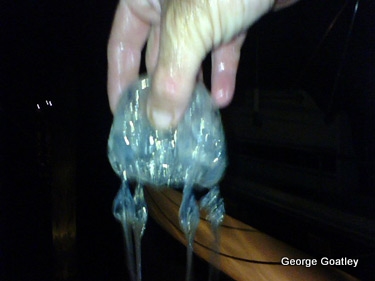
Various types of box jellies may be found in Florida waters. They can give a very very painful sting. The sting of certain varieties found in Australia can be fatal. Finally I have an actual photo of a box jelly, sent to me in Dec 2007 by George Goatley. George was snook fishing at night from a neighbor's dock on the intracoastal waterway. They were using a light to attract fish. He noticed several jellyfish actively swimming in the strong current as though they were aggressively hunting for food. George knew how to pick up the jelly without being stung (don't try this at home!) and was able to take this photo with his cell phone camera. He said it weighed about a pound. He also sent a video of the jelly swimming. If you are using a Microsoft Windows computer, the video should magically appear below. If you are using a Mac, click the link below to watch the video with Quicktime. Box jellyfish video for Quicktime Player
Thanks for the cool jellyfish video George!
|
|
|
|

Photo Copyright © C. Fesenmaier -- Edina,
Minnesota.
The above excellent photo of a By-the-Wind Sailor jellyfish was taken on Cape Canaveral, Florida beach the last weekend in March 2007. There were hundreds of them on the beach, blown ashore by the strong easterly winds. This jellyfish has a purple "raft" and a translucent flexible sail. The sail catches the wind and propels them like a sailboat.
The late Kathy Katz, in her excellent book "The Nature of Florida's Beaches" says the following about the By-the-Wind Sailor:
"About half of them are 'left
handed'...their sails are set opposite to the other half...so that during
violent storms, half will be carried to shore to provide food for beach
creatures while the other half will survive to continue drifting."
Kathy Katz, The Nature of Florida's Beaches ISBN
0-8200-1201-7
Link to Amazon.com
The Nature of Florida's Beaches I highly recommend this book if you love
beachcombing in Florida.
Below is a photo of a Velella velella next to someone's foot, to give you an idea of the size of the creature.

Photo Copyright © C. Fesenmaier-- Edina,
Minnesota.

Photo copyright © Mike McKay 2007
The above photo of what appears to be a Lion's Mane Jellyfish was sent to me by the McKay Family. They were diving Mike's Wreck on Elbow Reef off Key Largo. These jellies get quite large and pack a powerful sting. Many thanks to the McKay Family for taking the time to send this excellent photo to Beachhunter.

Comb Jelly
Comb Jellies
Comb jellies are not true
jellyfish (although they look like jellies). They do not sting. They are quite
common and are often difficult to see because they are quite transparent. They
do have some lines of iridescent coloring that can sometimes be seen. They are
small, only an inch or two long usually and are very slow moving. As you can
see from the image above, they have no stinging tentacles.
The best way to prevent jellyfish stings of course is to avoid coming into contact with jellyfish. Before swimming in the Gulf of Mexico, Atlantic, or Caribbean, look for flags on the lifeguard tower or signs warning of jellyfish or sea lice in the water. When approaching the water, look for signs of jellyfish on the sand (don't step on them). Scan the water and look for jellyfish floating on the surface, then as you enter the water, pay attention to the water around you. If you see a jellyfish, look around to see if it is part of a larger gathering of jellies. If so, I would strongly consider looking for a different place to swim. If there is only one, just avoid it. You can move a lot faster than a jellyfish can. If it has an inflatable float and purple tentacles, get far away from it and warn other bathers that a Portuguese Man-of-War jellyfish is in the area. Don't approach within 200 feet of a Portuguese Man-of-War. That's how far their tentacles may extend.
Please also consider that in rough water, or when predators like sea-turtles are feeding on them, the tentacles of jellyfish may break apart and float around in the water and in the surf. These pieces of tentacles can still give you a nasty sting.
Avoid touching dead jellyfish lying on the beach.
Finally, there is a
sunscreen called Safesea that can provide very good
protection from
jellyfish stings and protection from sea lice stings. It seems to prevent the jellyfish sting mechanism
from firing and is backed up by considerable research and testing.
Find out more and Order Safesea online.
Click on the link below to go directly to the SafeSea website:
Buy SafeSea jellyfish protection online.
More photos of Florida Jellyfish
Mild jellyfish Stings
If it is a small jellyfish and is not a Portuguese Man of War, rinse off the affected area. You might try pouring some vinegar over the area. Remove any tentacles still clinging to your body. If it is not too painful you may not have to do anything else. The pain should subside after an hour or less. You can try applying ice or heat for the pain, whichever feels better to the victim.
If the pain is intense or if you experience other symptoms like faintness, difficulty breathing, swelling, etc. , seek medical attention immediately.
Portuguese Man of War Stings:
* Get away from it and get out of the water. Try to get out of the water on your own so you will not expose others who may try to help you. Tentacles stick to your body and can easily rub off on someone else.
* Notify the lifeguards right away if the beach has lifeguards, they are trained in what to do.
* Do not put vinegar on a Man-of-War sting. It MAY cause more stings from remaining tentacles. If vinegar is all you have, you might try some on a very small section of the sting area to see if it helps or hurts.
* Remove any remaining tentacles from your body with tweezers if possible. If you must, you can use your fingertips. Don't rub with a towel or shirt! Rinse with sea water (fresh water will cause the remaining nematocysts to fire and sting you even more). It is reported that it may help to scrape the affected area with a shaving razor (not electric) to completely remove the stinging tentacles.
* Seek medical attention.
* If the victim is experiencing severe symptoms, call 911.
* Apply heat or cold to help alleviate the pain, whichever feels better to the victim.
Note: Most jellyfish stings are painful for half-an-hour or an hour, then the pain subsides with no lasting effects. Under some conditions a sting can be more serious and may create medical complications. The following circumstances can turn a jellyfish sting into a medical emergency:
* The person may have an allergic reaction.
* The person may be a young child.
* The person may be elderly and frail.
* The person may already suffer from serious medical conditions before the sting.
* The person may have been stung many times over a large portion of his or her body or may have received multiple stings from one of the more potent jellies.
* The person may have received stings to the mouth or eyes.
You do not have to be able to identify the exact type of jellyfish that stung you to get proper treatment. However, it would be helpful if you have a general description and if you can determine if it was a Portuguese Man-of-War. Sometimes a person never sees the jellyfish at all. If you are swimming in salt water and feel a sudden burning or stinging on your skin, it is probably a jellyfish. Get out of the water.
Any breathing difficulty or altered level of consciousness is a medical emergency. Call 911 immediately.
Note: This is general information on jellyfish stings for educational purposes and general awareness. It is not intended to be medical advice. Medical professionals have the latest details available to them on how to treat jellyfish stings.
Lately there are reports of numerous non-native jellyfish being found in the Gulf. Some of these varieties may be harmful. That's another reason to stay clear of them. The Australian spotted jellyfish is one of those exotic invaders. Although its sting is apparently mild, it is a voracious feeder on fish eggs, fish and shrimp larvae, and plankton. In fact, one source reports that it can filter the above from over 260,000 gallons of water daily. I find that rather difficult to believe, but the point is that it eats a lot. Needless to say, large numbers of these jellies in the Gulf of Mexico could pose a serious threat to native species of fish and other marine life.
Note: If you are knowledgeable about jellyfish in Florida and have information that you would like to contribute to this page, or if you have photos of jellyfish in Florida, or experience with jellyfish in Florida, please send me an email at beachhunter@beachhunter.net.
For additional information on jellyfish in the Gulf of Mexico, and more identification photos, I recommend that you visit the following website: http://dockwatch.disl.org/glossary.htm
Concerned about beach safety? Download my FREE ebook on staying safe at the beach!
Jellyfish in Florida