Florida Shark Attacks on BeachHunter.net

Home Page

Beach photos & info

Beach Guidebook

Media / Press

Links

Things you must Know

About BeachHunter

David's Beach Blog

Contact BeachHunter

Daily Beach Report

Beach Safety Menu - Things You Must Know
sharks | jellyfish | stingrays | rip currents | red tide | water quality | beach safety | sea lice
gulf water temperatures | lightning

Sharks, Florida beaches, and YOU!
Cobia swimming alongside a large shark
Cobia swimming with Shark


Sharks! Everyone's favorite fear. First you should know that there are LOTS of sharks in the Gulf of Mexico and in the bay waters. There always have been. In fact, there are so many sharks that if they really wanted to eat people, you would never be able to swim in the water. The fact is, sharks avoid people. I've watched large hammerhead sharks patrolling the beach in the morning. When they come upon a person swimming in the water, they make a large detour around the human. But sharks make mistakes. Sometimes the water is murky. Sometimes there are lots of fish around and the sharks are feeding recklessly. Sometimes people get chomped on. Most of the time the shark realizes its mistake and lets go with minor damage. But usually a few times a year, for some unknown reason, a large shark decides it wants an easy meal and attacks a person. I think it is aberrant behavior, but it does happen.


SHARKWATER

Note in the graphic below an interesting peculiarity. The amount of shark bites on the Atlantic Coast far exceeds the number on the Gulf Coast. However, the percentage of bites on the Gulf Coast that result in death is higher on the Gulf Coast.  A very high percentage of the east Atlantic coast bites are to the hands, feet, and legs of surfers. Notice also that the beaches that have the most surfers in the water have the most shark bites: Daytona, Cocoa Beach, Palm Beach. Note also that on the Gulf coast between Tampa Bay and the panhandle area there are no shark bites. This "big bend" area is mostly salt marsh and has no nice beaches or sandy barrier islands, so there are few swimmers and no surfers.


Above video: Nurse sharks have small mouths and small teeth, but when they bite, they lock down and don't let go. The only way you are likely to run afoul of a nurse shark is if you step on one (they can rest on the bottom), or if you are a diver and decide to harass one. As you can see in the video above, they don't let go. Imagine if this were an 8 footer. It could easily drown the diver.


If you are coming to Florida and want to see sharks up close and personal, you should go to Mote Marine Laboratory in Sarasota and see the shark tank. That's where I took the shark photo at the top of this page.

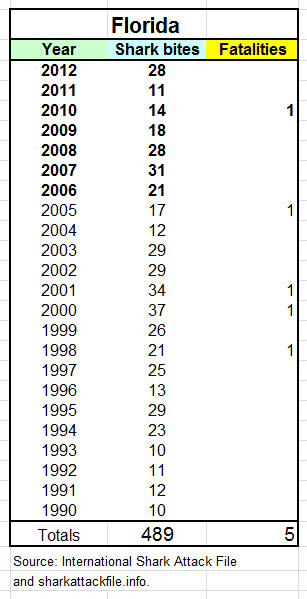
Shark bites: Fatal and Non-Fatal

The table below shows that between January 1990 and July 2005, out of 334 reported shark bites, only 4 were fatal. That’s about 1 in 100 bites that results in death. 

Since 1882 there have only been 13  recorded shark bite fatalities. Probably there were a few more back in the late 1800's and early 1900's that were not recorded, but the point is that relative to the millions of people that swim in Florida waters, the rate of fatalities is very small indeed.

Florida Shark Bites

Year Bites Deaths
2005 12 1
2004 12  
2003 30  
2002 29  
2001 34 1
2000 37 1
1999 26  
1998 21 1
1997 25  
1996 13  
1995 29  
1994 23  
1993 10  
1992 11  
1991 12  
1990 10  
Totals 334 4

The numbers in the table for 1990 through 2004 come from the International Shark Attack File maintained by the Florida Museum of Natural History. The 2005 numbers come from the Global Shark Attack File and from newspaper reports of shark bites in July of 2005 (all 3 of which were in Volusia County [Daytona area]).

The International Shark Attack File statistical analysis shows the following:

  • Since 1900, shark bites have increased in proportion to the population increase in Florida.
     

  • Between 1911 and 2004, more than half of Florida shark bites occurred during the months of July, August, September, and October. More than 85% of Florida shark bites occurred during the months March through October.
     

  • Most shark bites happen between 11am and 8pm.
     

  • The feet, legs, and hands of surfers are the most common target of sharks in Florida, followed by swimmers and waders, and finally divers. Swimmers were the most common victim before the 1960’s. Surfing became popular beginning in the 1960’s and the exponential increase in the presence of surfers in the water contributed to a major increase in shark bites.
     

  • The most bites are inflicted by Spinner, Blacktip, Hammerhead, and Bull sharks.

 From the above information, it is easy to see that there is a direct relationship between the increase in the presence of humans in the water and the increase in shark bites over time. As more and more people come to Florida and play in the water, it seems reasonable to predict that we will continue to see an increase in the number of shark bites over time. However, it is most important to consider the relative risk of being bitten by a shark. 

It is very important to understand that the increases in shark bites in the last few decades is not because sharks are more aggressive, or because they have developed a taste for humans, or because Fidel Castro has trained schools of sharks to attack us. It is only because there are more people going into the shark's world.


Shark Bites: Considering Your Risk

Out of all the people who enter the water every year, what percentage is bitten by a shark? Let’s make some rough calculations by looking at the numbers for 2004. According to statistics kept by the United States Lifesaving Association on beach attendance, about 20 million people visited the public beaches on the east coast of Florida and the Clearwater beaches on the Gulf coast in 2004. Florida averages about 20 shark bites per year. That works out to a chance of one in a million that any one person will be bitten by a shark.

 Many more than 20 million people normally visit the Florida Beaches. The above numbers were recorded at beaches with lifeguards. Many, if not more people swim at unguarded beaches. Also, the numbers don’t include the rest of the west coast beaches. Manatee, Sarasota, Charlotte, Lee, and Collier Counties have millions of people at their beaches as well.

Consider also that 2004 beach attendance was down by more than 25% because of the 4 hurricanes that struck Florida.  Also we should take into account that not everyone that goes to the beach actually goes in the water, and that historically, minor shark bites are under-reported. Overall, I think the 1 in a million estimate is reasonably conservative.  

3,000 people are killed every year in Florida…in car crashes. Three thousand. No kidding.

Now that we’ve established that our chances of being bitten by a shark are extremely small, let’s see what we can do to make that 1 in a million chance even smaller!


Reducing Your Chance of Being Bitten by a Shark

It is important to understand that people frequently encounter sharks without being bitten. Often a shark swims right by a person, who never realizes a shark is nearby. I recently saw a 3 foot shark hunting a school of mullet within 50 feet of a group of swimmers.

Based on what we think we know about sharks, and based on actual experiences and common sense, here are ways generally thought to minimize your chances of encountering a shark in a situation where it may bite you: 

  • Never enter the water if you are bleeding. This includes menstrual blood. According to the Mote Marine Lab website, sharks are much more interested in fish blood than in human or animal blood, but the long held belief is that you should not be in the water if you are bleeding. Sounds like a no-brainer to me. Needless to say, if you injure yourself while swimming and are bleeding, get out of the water. 

  • Avoid swimming during early morning and during the sunset hours. Sharks often come into shallow water to feed during those hours. Definitely don’t swim at night! 

  • Avoid swimming in murky waters.  Sharks rely on their sense of sight as well as other senses. They can see very well in the dark, but sediment and algae suspended in the water makes it hard for them to see you. They may bite you before they realize you are not a fish. It is also harder for you to see an approaching shark in murky water. Clear shallow waters give you a much better opportunity to see an approaching shark. 

  • Swim near other people. It seems that sharks are more likely to attack a swimmer that is alone or separated from a group. Some sharks prefer not to confront their prey; they want to sneak up from below or from behind. If they can’t do that, they may not bite.

  • Don’t swim too far from shore. Florida waters usually have a shallow sandbar a short distance from shore. The generally held belief is that going into the deeper water beyond the first sandbar MAY increase a person’s chance of encountering a shark. Also, being that far out makes it more difficult for help to reach you if you are in distress, for whatever reason. 

  • Don’t swim in schools of baitfish or mullet. If you see a lot of fish jumping and splashing it means they are trying to get away from a predator. This may mean that large fish are chasing and feeding on smaller fish, or it may mean the presence of sharks. It surely is a situation that might attract a hungry shark. Get out of the water and wait for the fish to go elsewhere. Flocks of sea birds diving repeatedly in one area are another indication that baitfish are present. 

  • Avoid fishing where people are swimming, and of course, avoid swimming where people are fishing. When a fish is hooked, its frantic movements to escape may attract sharks. I wouldn’t advise standing in the water you are fishing in. If you do, and you catch a fish, get the fish out of the water right away. Whatever you do, don’t tie a stringer of fish to your waist. 

  • Don’t jump off a pier, dock, seawall, or boat into dark murky water. You may startle a passing shark. Sharks are territorial and are quick to protect themselves by biting. Unfortunately this type of accident happened not long ago in St. Petersburg, Florida. A man jumped off his boat dock to take his daily swim in the bay and apparently jumped right on top of a shark swimming by in the dark water. The shark bit him and he died.
     

  • Don’t wear shiny objects while swimming. The gold or silver flash of a watch, ring, necklace, or bracelet looks just like the sun’s reflection off the scales of a fish underwater. Not only can this attract a shark’s attention, it can also attract the unwanted attention of a barracuda. Barracudas are notorious for striking at shiny objects. Barracuda can grow quite large and they move like lightning. Below is a photo of a 4 foot barracuda. I wouldn’t want it to mistake my watch for a fish!


  • Avoid swimming in or near passes, river-mouths, channels, drop-offs, or in deep water past the sand bars. Passes are the waterways between islands that allow water to move between the Gulf and the bays. Water moves swiftly through these passes and carries a lot of shark food with it. Don’t be there with the rest of the shark food. Anywhere there is an abrupt change in currents, salinity, or water depth there is increased food opportunity for fish and therefore sharks.
     

  • Avoid swimming with your dog. Dogs splashing around in the water are great shark attractors.
     

  • If you see sharks in the water, get out of the water as quietly and as quickly as possible. It doesn’t seem like I would have to say this, but some folks, especially surfers, tend to want to hang out for “one more wave.”
     

  • Like most large predators, sharks move around a lot. During the spring and early summer they move into shallow waters to give birth. Some shark species prey on the young (pups) of other sharks. This means a lot of hungry sharks are coming into shallow water at the same time people are heading to the beaches. You should especially avoid engaging in risky behaviors during those times.

After writing all that cautionary stuff, I must say  I've been swimming in the Gulf since I was a kid and I've never been bitten. In fact for several years as a teenager I spent a lot of time on a surfboard splashing around like a wounded seal before sunrise, long after sunset, in murky water, in the Atlantic Ocean and the Gulf of Mexico. So just follow common sense rules and there's a 99.9999999% chance you won't have any problem. Yeah, I know, I know...it's that .000000001% chance that gives you the creeps.


swimmers_too_far_out_6827.jpg (8517 bytes) Don't swim too far away from shore. This often means don't go past the sand bar. Check out the photo at left. Click to enlarge. Notice the swimmers have gone all the way out to where the lighter colored shallow water ends and the darker, deeper water begins. I drew a circle around the swimmers. They are probably 50 yards out from shore. Based on what we know about the feeding habits of sharks, these swimmers MAY be at a slightly higher risk of encountering a shark. (More likely they are at risk of being hit by a passing boat). Please bear in mind that your chances of encountering a shark are slim. You should be more concerned with your safety in driving to the beach.
 
wade_fishing_6828.jpg (9014 bytes) If you are fishing while wading in the water, don't tie a stringer of fish to your waist. In fact, get the fish to the beach as quickly as possible. The man in the photo at left is fishing in nearly chest deep water, not far from other swimmers. If he hooks a fish, he may attract a hungry shark.


Boca-Grande-Pass_and-Cayo-C.jpg (59247 bytes) At left is a view of the beach where, according to newspaper articles, an Austrian visitor was swimming when bitten on the ankle by a shark during the summer of 2005. Note how close it is to Boca Pass, well known for its high population of sharks. Not a good place to swim, particularly if you are in more than knee-deep. Not to mention the swift currents. Click on photo to enlarge.
Boca_Pass_sharkbite_locatio.jpg (24447 bytes) At left is a better view of the water where the Austrian was swimming when bitten. Note that the person in the water on the right side of the photo is in waist deep water and is only 30 feet from shore.  100 feet out would be in the darker, deeper water, past the drop-off. The water is beautiful though isn't it. This beach park is one of the most scenic on the Gulf coast.

Can You Fight Off a Shark?

This is open to debate.  As I mentioned before, some sharks want to sneak up on their victim from below or from behind. Once it is obvious that their prey has seen them, they go away. According to several written sources, Great White Sharks and Tiger sharks may fall into this category. Great White sharks are generally not seen in Florida. Tiger sharks do live in Florida waters.

Some individuals that study shark attack behavior suggest that certain sharks may be reluctant to bite a potential victim that is confronting them directly.  I don’t think this means that facing a shark will make it abandon its target. It may just mean the shark will try to circle around behind, or come up from underneath.

I’ve read of a multiple attack on a large turtle where the shark came up from deep water with such force that it lifted the turtle clear of the water. After losing a flipper the turtle withdrew into its shell. After periods when it seemed the shark was gone, it returned to attack from beneath, trying to catch the turtle off-guard. Sharks know how to hunt. 

Sharks are often shown on TV swimming in a slow, lazy way. When they are chasing their prey, they can move like lightning. You would be amazed to see a shark cover a 50 foot distance in about 2 seconds. Can you imagine being hit by a 300 pound object moving through the water at that speed?

A shark’s skin and tissue is very hard and tough, especially the head. Hitting the shark in the head will hurt your hand more than the shark. Even with a large knife it is unlikely you could even penetrate the sharks head.  It seems that if you are going to hit the shark, you should aim for the eyes or gills. Based on statistics collected, this seems to have the best chance of success.  

Recently (2005) there have been several reports from Australia of surfers fighting off a Bronze Whaler shark in separate incidents. Both surfers survived.  One shark was fairly small and the surfer escaped without injury. The larger shark (“several meters”) was not as easily dealt with and the surfer had some serious injuries. The Bronze Whaler shark is comparable to Florida’s Bull shark.


How to Help a Shark Bite Victim

1. Get the victim out of the water and away from the shark as quickly as possible. In more than 90 percent of cases, the shark does not try to bite the rescuers, but may continue to bite the targeted victim. 

2. Have someone call 911, of course. Send someone to notify the lifeguards immediately if there are lifeguards nearby. They are trained in what to do. 

3. Stop the bleeding.  Most shark bite victims die from blood loss.  Directly press with the palm of your hand on arteries that are bleeding. Apply pressure to arterial pressure points if you are familiar with them. 

4. Slightly elevate the victim’s feet and legs if possible so that blood moves toward the head. Cover the victim with dry towels, sheets or blankets, even if the weather is warm, to conserve their body heat.  

5. If the victim stops breathing or their heart stops, use cardiopulmonary resuscitation if you know how. 

The above measures are general emergency measures and may mean the difference between life and death for the bite victim.


If you're into data, charts, comparative analysis, statistics, etc. visit the International Shark Attack File page at the Museum Natural History by clicking on the following link: http://www.flmnh.ufl.edu/fish/Sharks/ISAF/ISAF.htm

Other cool shark links: For photos of Florida human/shark interactions click here http://gulfster.com/IndexFiles/SummerShark.html . As you can see, we aren't very nice to sharks either.  As was stated by a Florida Aquarium representative on a recent news story: "We kill a lot more of them [sharks] than they kill of us."

Here is a link to a popular video of a huge school of migrating sharks taken on Deerfield beach (Florida Atlantic coast). They are mostly blacktip and spinner sharks I understand. They appear like this for a few days and then disappear: http://www.nbc-2.com/BuildASX.asx?videofilename=050329_sharks.wmv&mswmext=.asx 


Be sure to download the FREE ebook I wrote on beach safety below.

It's FREE for download right now!

How to Be Safe From Sharks, Jellyfish, Stingrays, Rip Currents and other Scary Things on Florida Beaches and Coastal Waters. My new ebook tells you what you need to know to have a safe and fun stay on the Florida Islands and Beaches. Click the blue book cover at left to find out more information about what's in the book and to download to your computer. If you are a first-time visitor to the Florida Beaches, this book is a MUST! 70 pages with color photos and illustrations. Where else will you get this information?