Sharks | Jellyfish | Stingrays | Rip Currents | Lightning | Red tide |
Water Quality | Gulf Water temperatures | Sea Lice | General beach safety
| Location | JAN | FEB | MAR | APR | MAY | JUN | JUL | AUG | SEP | OCT | NOV | DEC | |
|---|---|---|---|---|---|---|---|---|---|---|---|---|---|
| Key West FL (average / Fahrenheit) | 69 | 70 | 75 | 78 | 82 | 85 | 87 | 87 | 86 | 82 | 76 | 72 | |
| Naples FL (averages) | 66 | 66 | 71 | 77 | 82 | 86 | 87 | 87 | 86 | 81 | 73 | 68 | |
| St. Petersburg FL (averages) | 62 | 64 | 68 | 74 | 80 | 84 | 86 | 86 | 84 | 78 | 70 | 64 | |
| Cedar Key FL (averages) | 58 | 60 | 66 | 73 | 80 | 84 | 86 | 86 | 83 | 76 | 66 | 60 | |
| Pensacola FL (averages) | 56 | 58 | 63 | 71 | 78 | 84 | 85 | 86 | 82 | 74 | 65 | 58 |
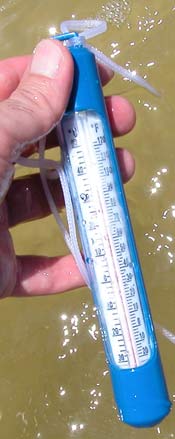
The above data is from the National Oceanographic data center. For current water temperatures you can visit their site at http://www.nodc.noaa.gov/dsdt/cwtg/egof_tmap.html
The above temperatures are AVERAGE temperatures during a given month. Also consider that most official temperatures are not recorded at the beach, but by buoys floating offshore, so that the "official" temperatures you see on the weather reports or in the table above are usually a few degrees warmer than the actual beach water temperatures during the winter, and a few degrees cooler than the actual beach water temperatures in the summer. This is because the shallow waters on the beach change temperature more quickly in response to weather conditions than the offshore waters.
Depending on the weather, water temperatures can run 5 to 7 degrees cooler or warmer than the averages in the above tables. Of course, the further south you go, the warmer the temperatures tend to be during the cooler months. This is clearly demonstrated in the table where the average water temperature in Key West is almost 70 degrees Fahrenheit in January, while hundreds of miles to the north at Pensacola the water temperature is in the mid 50's.
What's Cold Water and What's Just Right?
People have a wide range of preferences and tolerances for water temperatures. Generally, anything above 75 can be enjoyable. Most people seem to prefer water temperatures of about 85 degrees for swimming. The Gulf of Mexico can get into the low 90's during July and August. This is too warm for a lot of people, but I love it. It doesn't cool you off much though. Often during the summer months the water is actually warmer than the air, since the sea breeze along the Gulf Coast keeps the air temperatures in the upper 80's while in Orlando it might be 98 degrees (or higher).
Here's an idea of what water temperatures mean to you
-
50 - 60 degrees Fahrenheit - look out for polar bears.
-
61 - 70 - Canadians and British folk only.
-
71 - 75 - southerners will start to wade in the water. Canadians, northerners & Brits will stay in all day.
-
76 - 80 - Nearly everyone will swim in these temperatures. 76 is a bit cool, but 80 is just about perfect for everyone.
-
81 - 86 - Perfect for a long refreshing swim. A quick dip will ward off overheating on a hot day.
-
86 - 91 - Very warm. Jump right in. Doesn't cool you off much.
-
92 and up - Like bath water. Perfect for Florida natives like me. Around sunset, the water is actually warmer than the air. You'll find water temps above 90 during July & August on the Gulf coast. 96 or even 98 degrees is not unheard of in the Gulf of Mexico along the beach.
 |
Medically supported First-aid pain relief products for marine stings including the Portuguese Man O War, Stingray, Sea Urchin, Fire Coral and, a variety of jellyfish sting injuries. Ocean Care Solutions. |
 |
|
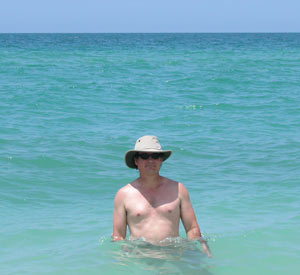
Beachhunter enjoying 80 degree water.
