Jellyfish in Florida on BeachHunter.net

Home Page

Florida Beaches Index

Beach Guidebook

Media / Press

Links

Things you must Know

About BeachHunter

David's Beach Blog

Contact BeachHunter

Beach Forum

Beach Safety Menu - Things You Must Know
sharks | jellyfish | stingrays | rip currents | red tide | water quality | beach safety | sea lice
gulf water temperatures | lightning

Jellyfish in Florida - Jellyfish Identification

Main Jellyfish page | more jellyfish photos | man-of-war | blue buttons | jellyfish stings | videos of swimming jellyfish

Ocean Care Solutions Logo: Marine Sting Treatments  
Ocean Care Solutions provides effective, medically supported First-aid pain relief products for marine stings including the Portuguese Man O War, Stingray, Sea Urchin, Fire Coral and, a variety of jellyfish sting injuries. 

Ocean Care Solutions Jellyfish Sting First Aid solution
   
moon jellyfish | Aurelia aurita
Moon Jellyfish
cannonball jellyfish | Stomolophus meleagris
Cannonball Jellyfish (aka Cabbagehead)
Portuguese man-of-war | Physalia physalis
Portuguese Man-of-War
sea nettle jellyfish | Chrysaora quinquecirrha
Sea Nettle Jellyfish
blue button jellyfish | Porpita porpita
Blue button jellyfish
by-the-wind sailor jellyfish | Velella velella
By-the-wind Sailor jellyfish
mushroom cap jellyfish
Mushroom cap jellyfish
Purple jellyfish | mauve stinger | Pelagia noctiluca
Mauve Stinger (Purple Jellyfish)
box jellyfish
Box Jellyfish
mesoglea from jellyfish
Mesoglea (jellyfish tissue)


Jellyfish are common in Florida, but they are not everywhere all of the time. I have been swimming inthe Gulf of Mexico for my whole life and I’ve never been stung by a jellyfish. If you keep your eyes open they are easy to avoid. Sometimes, in some locations, a large mass of jellyfish will “invade” the beach. Some jellyfish are harmless, others have a relatively mild sting, some creatures look like jellyfish but really are not. Two jellyfish in particular, the Portuguese Man of War, and the box jellyfish can give a very painful sting. Another type, comb jellies, are not true jellyfish and do not sting.

Many jellyfish have tentacles that trail down from their bodies into the water. The tentacles have stinging cells, called nematocysts, that have tiny harpoons and venom. When the tentacles touch something, or are otherwise stimulated, the nematocysts build up pressure until they burst, driving the little harpoons and the venom into the unlucky victim. Some jellyfish have very weak venom, others have extremely potent venom, which upon sufficient exposure, can result in the death of a human (exceedingly rare in Florida waters).

I am not a jellyfish identification expert and I’m sure you aren’t either.  So I would advise that you observe jellyfish from a safe distance and don't touch them or step on them. There are many different types of jellyfish in Florida waters, including some exotic invasive species with an unpredictable distribution. Below are several of the more common types:


Moon Jellyfish (Aurelia aurita)

moon jellyfish photo by david mcree.jpg
Moon Jelly

The Moon jellyfish (Aurelia aurita) can occur in very large numbers in one place. It is a beautiful jellyfish, and most reports sugges that its sting is so mild that only very sensitive people can feel it at all. Many people can handle this jellyfish without feeling a sting except perhaps on sensitive areas of the body. Above is a photo of a moon jelly washed up on the beach. It is about 7 inches in diameter.

 
Moon Jellyfish - Aurelia aurita - Santa Rosa Beach, Florida from David McRee on Vimeo.


Cannonball Jellyfish (Stomolophus meleagris)
 
Here's my hand next to a Stomolophus for size comparison.

The cannonball jellyfish [Stomolophus meleagris], also known as the cabbage head jellyfish, is a harmless (it’s edible) variety that sometimes washes up on beaches in large numbers. It is shaped like half an egg and may be up to 7 inches in diameter. It may be bluish or yellowish with a brown border. It is a good swimmer. The venom of the cannonball can give a mild sting, but generally, brushing against this jelly isn't enough to result in a sting. It goes without saying, that what would be a mild sting on the skin will be a very strong sting if the nematocysts get into your eyes.

The Cannonball Jellyfish is considered a delicacy in Japan, but it must be prepared properly, which usually means it is dried. However, you must understand that to be edible, it must be harvested while still alive and healthy. The ones washed up on the beach should not be eaten because once they are beached they decompose rapidly. Yuck!

Stomolophus meleagris on a Florida Beach
St. Augustine beach is the end of the line for this cannonball jelly (above.)

 S. Medrock sent in the photo above of his arm after he said bumped into a cannonball jelly, which left a dark brown gel on his arm. He said it was painful for about 6 hours. The next day it was very itchy and required hydrocortisone applications. This is the first report I've received of a cannonball jelly stinging. Anyone else out there with info? Send me an email, or post on the forum.

Update: Received a contribution of information from Dr. Richard Courtney with more info on the Cannonball jelly's ability to sting. Below are several quotes from Dr. Courtney's email:

"I'm a former instructor at the Naval Diving and Salvage Training Center in Panama City, FL. Taught the Dangerous Marine Life curriculum there, and for the FSU Scientist in the Sea Graduate Program.

There is a huge bloom of cannonballs off the Panama City to Pensacola coast every year, thick. We surfed the jetties at the entrance to St. Andrew's Bay. Paddling through the jellies was no issue. The small tuft of tentacles sticking out of the "ball" never seemed to sting us. When surfing, the skeg
[surfboard fin] would hit them staccato, bap, bap, bap........ there were that many in the water.
 
So one afternoon a Navy pal decided to bean me with a cannonball jelly while I was surfing. The ball struck my arm, ruptured the jelly, and left a mildly stinging path across my arm and chest, no big deal. My buddy, laughing with glee at the impact, reached up to rub water from his eyes. Big mistake. He rubbed a few stray nematocysts into his eye from the jelly. Yow! That was the end of his surf day, red eyed and painful. It cleared up pretty quick, that day, no damage done. I was left with a little red itchy rash on my arm for about 2 days.
 
I think the relative mildness of the Cannonball Jelly sting is due to two main factors. First, the tentacles are short, largely encased in the jelly shroud, so contact is rare. Second, not all nematocyst are created equal. I suspect the stingers on the cannonball are small, poor penetration of thicker skin (but eyeballs, sclera and cornea, are quite delicate). Lastly, pure conjecture, but the venom may be rather impotent.
 
But make no mistake, a Cannonball Jelly can raise a welt, and bring a tear to your eye."

This is great information and I appreciate Dr. Courtney's addition to our knowledge of the Cannonball Jellyfish.

More info: I read a Wikipedia entry about the Cannonball Jelly that says it does not generally sting. However, it does secret a toxin that is not only irritating to the skin, but MAY also cause irregular and dangerous heart rhythms. HOWEVER, the scientific study that the article references involves injecting the toxin directly into the bloodstream of rabbits and rats. The article's abstract does not say anything about effects on humans. So I would be very reluctant to conclude that merely coming into contact with a cannonball jellyfish could be harmful to the heart. I can find no specific reference (except in the Wikipedia article) that contact with a Cannonball (Cabbagehead) jellyfish is dangerous to humans. Here is a technical description of what the Cannonball jelly toxin can do to the heart of rabbits and rats.

Here is what Wikipedia says: "When disrupted the cannonball secretes a mucus out of its nematocyst that contains a toxin. The toxin harms small fish in the immediate area, and drives away most predators, except for certain types of crabs. Although cannonballs do not commonly sting humans, it still has toxins which can cause cardiac problems in animals and humans. The toxin causes irregular heart rhythms and problems in the myocardial conduction pathways. Such complications are associated also with toxins of other coelenterates. The toxin is also harmful to the eyes, when the nematocyst comes in contact with eyes it is very painful and is followed with redness and swelling."

Here's a link to the Wikipedia article: http://en.wikipedia.org/wiki/Cannonball_Jellyfish


Sea Nettles are the typical-looking jellyfish--a rounded bell with long flowing tentacles. A visible characteristic of this jelly is orange-brown stripes radiating from the center of the bell toward the edges. The ones you see in the Gulf of Mexico tend to have noticeably more colorful stripes than the ones you see in the bays and canals. Note how the ones pictured below are very light in color. They to have a sharp sting, but most reports indicate that the pain subsides after an hour or so.

Above & below: Sea nettle in a canal in Cape Coral, FL.
Photos taken 9/3/07 and sent in by a helpful observer.


stinging jellyfish swimming in the Gulf of Mexico
Photo copyright © Tami Swain--Florida


The above photo of a sea nettle jellyfish was contributed by Tami Swain. It was about 200 yards off Caladesi Island in the Gulf. She was stung by it, or another like it. This one has long stinging tentacles trailing several feet behind it. Tami says the tentacles wrapped around her ankle when she was swimming. Tami writes: " I can only describe it as having an electrical wire wrapped around your skin with someone hitting the “on” switch.  It lasted for about ˝ hour and finally faded.  Now I only have some small little redmarks to show for it."  ...Thanks to Tami for sending this photo!


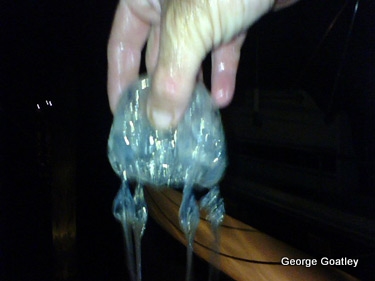
Camera phone photo of box jellyfish by George Goatley of Boynton Beach, FL

Various types of box jellies may be found in Florida waters. They can give a very very painful sting.  The sting of certain varieties found in Australia can be fatal. Finally I have an actual photo of a box jelly, sent to me in Dec 2007 by George Goatley. George was snook fishing at night from a neighbor's dock on the intracoastal waterway. They were using a light to attract fish. He noticed several jellyfish actively swimming in the strong current as though they were aggressively hunting for food. George knew how to pick up the jelly without being stung (don't try this at home!) and was able to take this photo with his cell phone camera. He said it weighed about a pound. He also sent a video of the jelly swimming. Click the link below to watch the video with Quicktime.

Box jellyfish video for Quicktime Player

Thanks for the cool jellyfish video George!


photo of Portuguese Man-O-War, copyright J. Keller 2007
Many thanks to J. Keller for sending in this beautiful photo of a Portuguese
Man-O-War taken 3/29/07 on Cocoa Beach, Florida. Copyright © J. Keller.

Probably the most dangerous jellyfish in Florida is the Portuguese Man of War [Physalia]. It is unmistakable, even if you’ve never seen a jellyfish before. It has a clear inflatable float that stays on top of the water like a little balloon. The rest of the animal is purple, and the purple tentacles can dangle underneath and behind the jellyfish for 50 to 200 feet, depending on the size of the jellyfish. 

man o war jellyfish picture from puerto rico 

At left is a photo of a man-o-war sent to BeachHunter by Priscilla from  Puerto Rico. The photo was taken on Playa Ballena, Guánica, Puerto Rico. Priscilla and her friend saw the jellyfish in the water and went near it to have a closer look. The beast stung her friend on the foot, and when Priscilla tried to help, she got stung on the hand and foot. The next day she had what she described as "stains" on various parts of her body, even where she felt no pain. She ended up going to the hospital with chest pains and abnormal blood pressure. Fortunately she got better and is O.K.

Thank you Priscilla, for sharing your story and the photo with everyone. I'm sure you won't be going near jellyfish again soon.

Photo: Copyright © Priscilla de Llovio 2007


For a really insane large hi-res photo of the Man-O-War below, just click on the photo. Cable or DSL internet connection preferred. Thanks again to Sarah Obrien for this outstanding photo taken on Gulf Shores, Alabama. Viewing tip: After the photo loads in your browser, press the F11 key. Press F11 a second time to return your browser window to normal viewing mode.


Photo Copyright © Sarah Obrien 2007

Actually the Portuguese Man-of-War is not a true jellyfish. It is a siphonophore and is actually a colony of four kinds of polyps suspended beneath the nitrogen filled balloon-like float that is the identifying characteristic of Physalia. The float may be only a quarter of an inch long or it may be up to a foot long and six inches above the water.  The float acts like a sail. The sting of a Portuguese Man of War is very very painful and dangerous. It could be fatal if a person received enough stings. Even after the jellyfish has washed up on the beach dead and has dried up, the tentacles can still sting you. Below is an illustration of a man-of-war.  The float is clear, and the tentacles are various shades of purple. It is unmistakable. They can be very small sometimes. The small ones are easy to pick up if you hold them by the inflated balloon float, making sure not to touch the purple tentacles, though I don't think the small ones have a very bad sting.

Sea turtles enjoy eating man-o-war jellies and do not suffer any stings.


Above is an absolutely marvelous photo of a Man-O-War on the beach at Gulf Shores, Alabama.
Many thanks to Sarah Obrien for this photo showing the very dangerous tentacles of the jellyfish.
Photo taken with a Canon Powershot A520 on 3/31/07. Copyright © Sarah Obrien 2007

Don't let the small size of some specimens catch you off guard. I've read estimates of as many as 500,000 man-of-war stings each summer along the eastern coast of the United States. I'm not sure of the origin of that number.


Above: A closeup of the stinging tentacles of the Man-O-War. Copyright © Sarah Obrien 2007.

man-of-war jellyfish photo.jpgHere is a photo of a very small man-of-war taken on Delray Beach, Florida (Atlantic coast) on 12/21/06 by  Julee D. of Ohio while on vacation. Her husband was stung on the foot as he walked along the beach. A surge of water washed over his feet, and carried with it this menacing little creature. This specimen looks to be about 2 or 3 inches in size. Imagine what a large one could do.

Man-o-war are common along the lower east coast of Florida during periods of east and southeast winds. They are blown onshore by the thousands. If you swim near lifeguards, pay attention to the signs on the lifeguard towers before entering the water. They will normally give warnings when dangerous marine creatures are present. Thank you, Julee, for the great photo of this man-of-war!

For more photos and one person's well written and informative account of his painful brush with a Man-of-War, go here: http://members.iconn.net/~marlae/manofwar/profile.htm  and especially see www.portuguesemanofwar.com to see what a bad sting looks like. Scroll down this page to see a photo of a mild sting.

To read some really good information about Portuguese Man of War stings visit
http://www.key-biscayne.com/beach_park/facts/manowar.shtml , you'll learn that some of the "treatments" often cited can cause more harm than good. In particular, this article casts doubt on the use of vinegar with man of war stings.

marine sting first aid kits from Ocean Care SolutionsBased on what people are telling me (people who were stung and treated by lifeguards) Florida lifeguards are still using vinegar. Remember that when someone is stung by a jellyfish, it is often impossible to know exactly what kind it was. Vinegar is considered effective on many types of jellies. My own personal interpretation of what I'm reading is that the VERY FIRST order of business, once the victim is out of the water, is to remove any tentacles that may be still clinging to the skin. This should be done BEFORE vinegar is applied, to reduce the possibility that the application of vinegar might cause the jellyfish's nematocysts to sting more. The tentacles can be washed away with sea water (not fresh water, and not with urine) or rubbed away with sand or even scraped off with a credit card or shaving razor.

Most people don't carry vinegar to the beach with them, so one of the simplest and most effective things to do is to buy a first-aid kit specifically designed to treat stings from jellyfish and other marine animals. Click to visit the Ocean Care Solutions web site. The kits are waterproof, too.


Below is a great photo of a Portuguese Man-O-War sent to me by Sandra and Chuck Beaulier of Danville, Ill. This photo was taken 3/24/07 on Cocoa Beach, FL. Chuck notes that they saw jellyfish from 1/4 inch in size up to the size of this specimen, which appears to be 4 or 5 inches across.

photo of a portuguese man-o-war jellyfish

Below: Colleen sent this photo from New Smyrna Beach, FL. An unknown jellyfish stung her on the calf. Based on her description of the event, I think it was a small Man of War. Read her story in the BeachHunter forum. Click on "Common Beach Questions and Answers" and then on the topic "What kind of jellyfish stung me?"


photo copyright © Colleen 2007

See more photos of jellyfish stings

Portuguese Man-of-War Video Clip and more great photos!

              
Clearwater Beach lifeguard stung by Portuguese Man-of-War (article in St. Pete Times) - "When it first hit me, it felt like a hot knife going in," said Moeller, who has monitored Clearwater's shorelines for the past five years. "The pain, it was bad, really bad."

He was rushed to the beach's nearby fire station where they hooked him up to a saline IV and treated his body with alcohol. As fire rescue crews monitored his heart rate, he became dizzy and even briefly passed out. Read the full story in the Times


Blue buttons are small blue discs with tentacles appearing as blue/purple fringe. They are quite small and often appear by the hundreds or thousands on the beach. The Florida Panhandle region and the Atlantic coast is where you are most likely to see them. Most people say they do not sting, but a few people seem to be sensitive to them.

I've received many reports of blue buttons on Florida Beaches as well as on other beaches in the southeastern US, so I created a record of all the sightings that were reported to me. You can see my record of blue button jellyfish sightings here.

BBelow is a photo sent in by Katherine Fowler of Panama City, Florida. It is an excellent photo of porpita porpita/i>,, taken May 6, 2007. Thanks Katherine, for this most excellent photo of a beautiful jellyfish.

Blue Buttons have their own page now! Visit my Blue Button page for more interesting information and a fantastic close-up of a beautiful Blue Button from Miramar Beach, FL.


photo copyright © Katherine Fowler 2007/font>


By-the-Wind Sailor jellyfish photo
Photo Copyright © C. Fesenmaier -- Edina, Minnesota.

The above excellent photo of a By-the-Wind Sailor jellyfish was taken on Cape Canaveral, Florida beach the last weekend in March 2007. There were hundreds of them on the beach, blown ashore by the strong easterly winds. This jellyfish has a purple "raft" and a translucent flexible sail. The sail catches the wind and propels them like a sailboat.

The late Kathy Katz, in her excellent book "The Nature of Florida's Beaches" says the following about the By-the-Wind Sailor:

"About half of them are 'left handed'...their sails are set opposite to the other half...so that during violent storms, half will be carried to shore to provide food for beach creatures while the other half will survive to continue drifting." Kathy Katz, The Nature of Florida's Beaches ISBN 0-8200-1201-7
Link to Amazon.com The Nature of Florida's Beaches I highly recommend this book if you love beachcombing in Florida.

Below is a photo of a Velella velella next to someone's foot, to give you an idea of the size of the creature.

Velella velella photographed on Cape Canaveral Beach, Florida
Photo Copyright © C. Fesenmaier-- Edina, Minnesota.


Unknown Jellyfish

Unknown Jellyfish. Probably a Pink Meanie (Drymonema)
Photo copyright © Mike McKay 2007

The above photo was sent to me by the McKay Family. They were diving Mike's Wreck on Elbow Reef off Key Largo. I'm not sure of the species, but I think it may be a Drymonema dalmatinum, otherwise known as a Pink Meanie. This is a jellyfish that eats other jellies. They have been discovered in the Gulf of Mexico. Many thanks to the McKay Family for taking the time to send this excellent photo to Beachhunter.


comb jelly illustration
Comb Jelly

Comb Jellies

Comb jellies are not true jellyfish (although they look like jellies). They do not sting. They are quite common and are often difficult to see because they are quite transparent. They do have some lines of iridescent coloring that can sometimes be seen. They are small, only an inch or two long usually and are very slow moving.  As you can see from the image above, they have no stinging tentacles.


Preventing jellyfish stings.

The best way to prevent jellyfish stings of course is to avoid coming into contact with jellyfish. Before swimming in the Gulf of Mexico, Atlantic, or Caribbean, look for flags on the lifeguard tower or signs warning of jellyfish or sea lice in the water. When approaching the water, look for signs of jellyfish on the sand (don't step on them). Scan the water and look for jellyfish floating on the surface, then as you enter the water, pay attention to the water around you.  If you see a jellyfish, look around to see if it is part of a larger gathering of jellies. If so, I would strongly consider looking for a different place to swim. If there is only one, just avoid it. You can move a lot faster than a jellyfish can. If it has an inflatable float and purple tentacles, get far away from it and warn other bathers that a Portuguese Man-of-War jellyfish is in the area.  Don't approach within 200 feet of a large Portuguese Man-of-War. That's how far their tentacles may extend. They have very good control over their tentacles and can reach out a considerable distance.

Please also consider that in rough water, or when predators like sea-turtles are feeding on them, the tentacles of jellyfish may break apart and float around in the water and in the surf. These pieces of tentacles can still give you a nasty sting. 

Avoid touching dead jellyfish lying on the beach.


More photos of Florida Jellyfish


What to do if you are stung by a jellyfish in Florida waters:

Mild jellyfish Stings

If it is a small jellyfish and is not a Portuguese Man of War, rinse off the affected area. You might try pouring some vinegar over the area. Remove any tentacles still clinging to your body. If it is not too painful you may not have to do anything else. The pain should subside after an hour or less. You can try applying ice or heat for the pain, whichever feels better to the victim. Recent field tests indicated that heat of 113 degrees Fahrenheit for about 15 minutes is effective at relieving the pain of a jellyfish sting.

If  the pain is intense or if you experience other symptoms like faintness, difficulty breathing, swelling, etc. , seek medical attention immediately.

Portuguese Man of War Stings:

* Get away from it and get out of the water. Try to get out of the water on your own so you will not expose others who may try to help you. Tentacles stick to your body and can easily rub off on someone else.

* Notify the lifeguards right away if the beach has lifeguards, they are trained in what to do.

* Application of vinegar is the standard and accepted method of treating jellyfish stings. Be aware that there is some disagreement as to whether vinegar should be used on man of war stings. The purpose of the vinegar is to stop any stinging cells that are still stuck to your skin from stinging you.

* Remove any remaining tentacles from your body with tweezers if possible.  If you must, you can use your fingertips. Don't rub with a towel or shirt! Rinse with sea water (fresh water will cause the remaining nematocysts to fire and sting you even more). It is reported that it may help to scrape the affected area with a shaving razor (not electric) to completely remove the stinging tentacles.

* Seek medical attention.

* If the victim is experiencing severe symptoms, call 911.

* Apply heat or cold to help alleviate the pain, whichever feels better to the victim. Certain recent field tests indicate that the application of heat to the jellyfish sting is effective at relieving the pain. Specifically, 113 degrees Fahrenheit for about 15 minutes is recommended.

Note: Most jellyfish stings are painful for half-an-hour or an hour, then the pain subsides with no lasting effects. Under some conditions a sting can be more serious and may create medical complications. The following circumstances can turn a jellyfish sting into a medical emergency:

* The person may have an allergic reaction.

* The person may be a young child.

* The person may be elderly and frail.

* The person may already suffer from serious medical conditions before the sting.

* The person may have been stung many times over a large portion of his or her body or may have received multiple stings from one of the more potent jellies.

* The person may have received stings to the mouth or eyes.

You do not have to be able to identify the exact type of jellyfish that stung you to get proper treatment. However, it would be helpful if you have a general description and if you can determine if it was a Portuguese Man-of-War. Sometimes a person never sees the jellyfish at all. If you are swimming in salt water and feel a sudden burning or stinging on your skin, it is probably a jellyfish. Get out of the water.

Any breathing difficulty or altered level of consciousness is a medical emergency. Call 911 immediately.

Note: This is general information on jellyfish stings for educational purposes and general awareness. It is not intended to be medical advice. Medical professionals have the latest details available to them on how to treat jellyfish stings.

Lately there are reports of numerous non-native jellyfish being found in the Gulf. Some of these varieties may be harmful. That's another reason to stay clear of them. The Australian spotted jellyfish is one of those exotic invaders. Although its sting is apparently mild, it is a voracious feeder on fish eggs, fish and shrimp larvae, and plankton. In fact, one source reports that it can filter the above from over 260,000 gallons of water daily. I find that rather difficult to believe, but the point is that it eats a lot. Needless to say, large numbers of these jellies in the Gulf of Mexico could pose a serious threat to native species of fish and other marine life.                                        

Note: If you are knowledgeable about jellyfish in Florida and have information that you would like to contribute to this page, or if you have photos of jellyfish in Florida, or experience with jellyfish in Florida, please send me an email at beachhunter@beachhunter.net.

For additional information on jellyfish in the Gulf of Mexico, and more identification photos, I recommend that you visit the following website: http://dockwatch.disl.org/glossary.htm  

Here is another excellent jellyfish site.

Here is an interesting and informative site about jellyfish envenomations published by The Medical Journal of Australia. 


Concerned about beach safety? Download my FREE ebook on staying safe at the beach!

It's FREE for download now!

How to Be Safe From Sharks, Jellyfish, Stingrays, Rip Currents and other Scary Things on Florida Beaches and Coastal Waters. My new pdf ebook tells you what you need to know to have a safe and fun stay on the Florida Islands and Beaches. Click the blue book cover at left to find out more information about what's in the book and to download to your computer. If you are a first-time visitor to the Florida Beaches, this book is a MUST! 70 pages with color photos and illustrations. Where else will you get this information?


Jellyfish in Florida/font>