A quick tour of the natural characteristics of some typical SW Florida beaches.
Click on photos to enlarge for viewing.
|
|
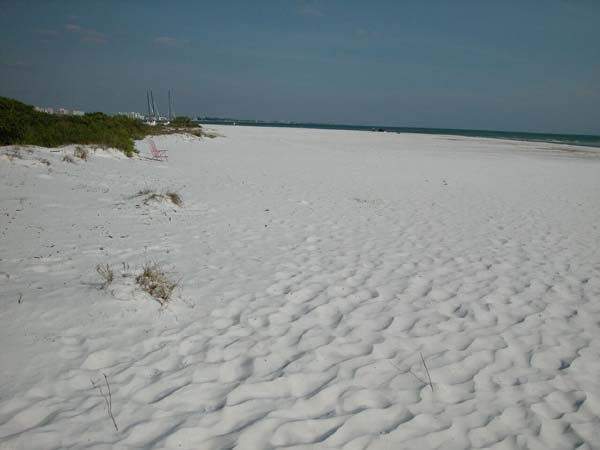
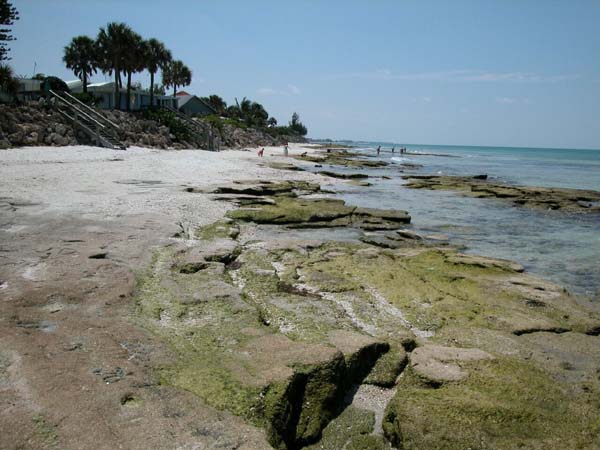
Florida beaches can almost all be described as flat and sandy. A perfect example is Siesta Key Public Beach, above left. An unusual land feature along the lower Gulf coast is the flat limestone rock formation along the shoreline at Point-of-Rocks beach on Siesta Key, above right photo. The two photos above are taken at beaches only about 3 miles apart on the same island..
While flat and sandy is a general description of most of the beaches in Florida, the more discerning eye can easily find an amazing degree of variety in beaches only a few miles apart. Most of the beaches along the lower west coast of Florida are on barrier islands (Naples and Venice beaches are exceptions). Barrier islands are usually oriented in a north-south direction and are separated from the mainland by a relatively narrow and shallow bay. One exception to this is Sanibel Island which has an east-west orientation, positioning it perfectly to catch shells carried northward by the currents.
The personality of each beach is influenced by the degree and type of development along the shoreline, the state of the backshore and the health of the dunes, the type of sand, the slope and width of the beach, the temperature, color, and depth of the water, and the type of activity going on along the shore.
Some beaches, like Fort Myers Beach and the Longboat Key beaches have a heavily developed shoreline, while Caspersen beach in Venice, and most beaches of Sanibel Island have quiet undeveloped shorelines. Fort Myers beach is a very commercial area with rental beach houses, restaurants, bars, and souvenir shops. Longboat Key is very upscale, with luxury condominiums along the shore, and is favored by many European visitors. Below photo shows the undeveloped shoreline along Caspersen beach in Venice, Florida and its laid-back visitors. Notice that the palm trees on the beach are native Florida Cabbage Palms rather than coconut palms. To find beautiful healthy coconut palms you need to go at least as far south as the Ft. Myers beaches. The best stands of coconut palms are on the Naples beaches. A great view of a palm fringed beach is had by walking out on the Naples pier at 12th Street South. What a view!
 |
One of the most picturesque forms along the beach is the sand dunes. Dunes are formed by blowing sand that piles up on the upper beach above the high tide line. They are covered by a grassy plant called "sea oats" which helps to stabilize the dunes. Although sea oats make beautiful dried arrangements for the home, they are protected by law. It is illegal to pick them. Most of the beaches in southwest Florida have dunes that have been damaged by development, storms, or foot and vehicle traffic. Some effort is being made to restore and repair damaged dunes by planting sea oats in fenced-off areas. In order to increase the chances for successful dune restoration, boardwalks are built to allow visitors to walk over the dunes without damaging them. Below left is a photo of the dunes at Turtle beach in Sarasota with the wooden walk-overs from the parking lot to the beach. The dunes are about 8 feet tall. Below center photo is just south of Venice beach and shows the rows of newly planted sea oats well on their way to creating a dune field. The Venice fishing pier is in the distance. Below right photo was taken 3 years after the center photo at the same location. The undisturbed sea oats have developed into a dense protective stand.
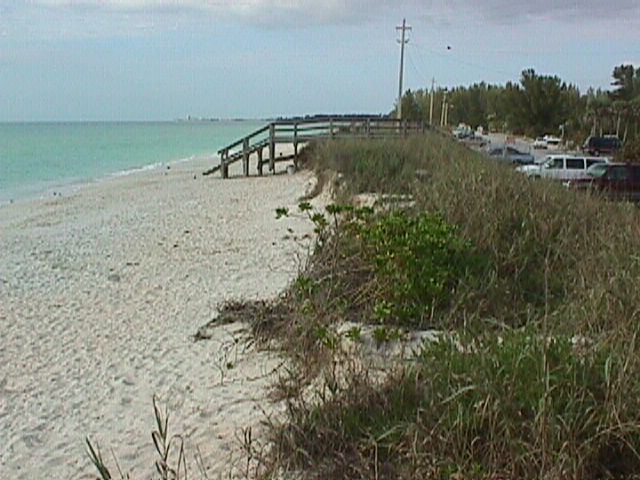 |
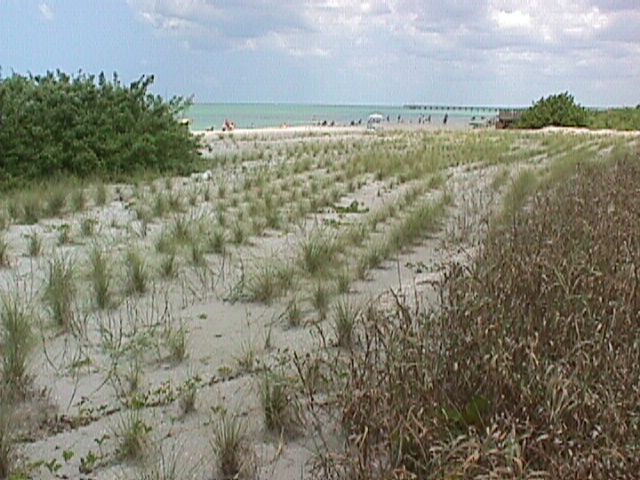 |
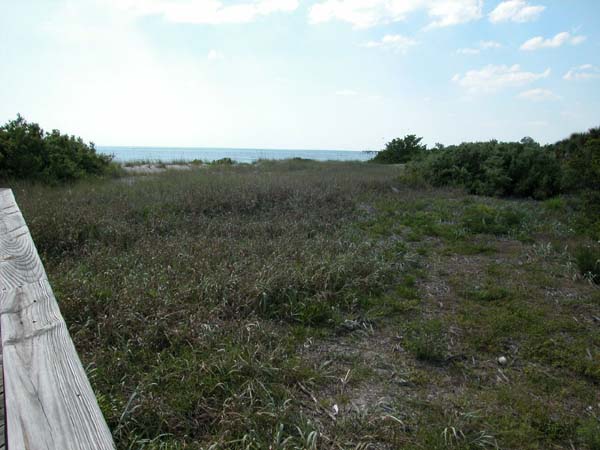 |
Other common plants along the Gulf beaches are Australian pines, coconut palms, sea grapes, cabbage palms, yucca, prickly pear cactus, and beach morning glory. Mangroves are mostly found along the bay side of the islands, but some are found along the Gulf as well.
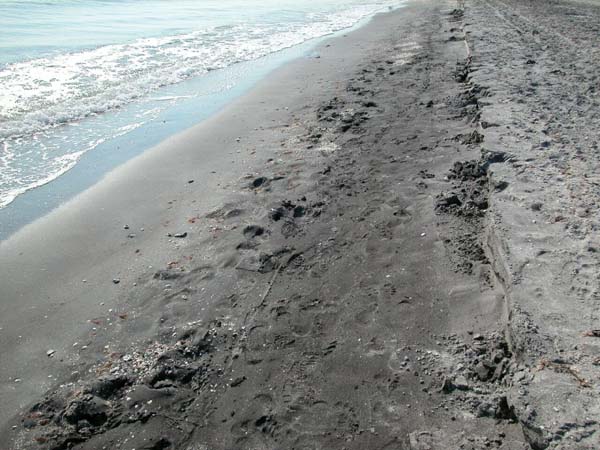
There are 3 common types of sand to be found on the beaches of southwest Florida. My favorite, white quartz crystal sand, is common on Anna Maria, Longboat Key, Lido Key, and Siesta Key. Black sand, containing dark fossilized material is found along Venice Beach. Brown sand, composed largely of tiny shell fragments is found along Turtle beach, as well as other beaches to the south. You can find different types of sand all over. The beaches I've just named are simply the best representative beaches for that type of sand. If you are wondering what's the big deal about sand, I'll tell you. White sand is the cleanest and is the easiest to walk on because it packs firm. On Siesta beach it packs so firmly near the water that you can ride a bike on it. Try that on brown shelly sand and you'll get nowhere except sunk up to the axles. Brown shelly sand is even a chore to walk in. Great exercise for the legs though. Black sand is not as reflective as white sand, so it gets hotter under the blazing sun. It can be uncomfortable for really tender feet, unless you are down by the water.
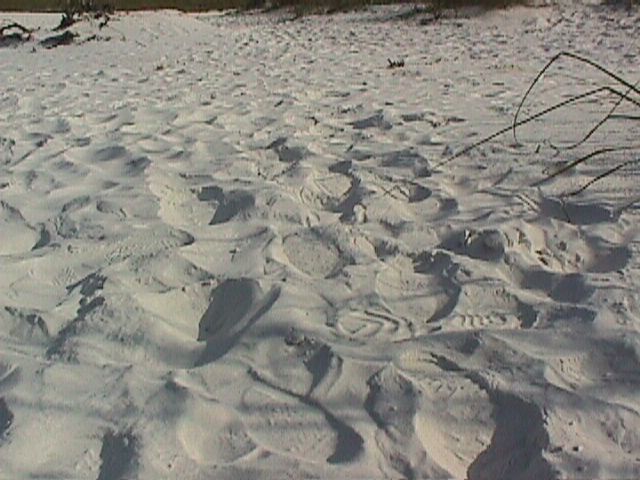 |
 |
|
Above left: Gleaming white quartz sand on northern Longboat Key. Center: Light brown shelly sand on Turtle beach. Above right: Black fossil-containing sand on Caspersen beach, just south of Venice.
Black sand is interesting because it contains fossils, especially fossilized shark's teeth. Venice beach is famous for its fossilized sharks teeth to the point of having a shark's tooth festival each year.
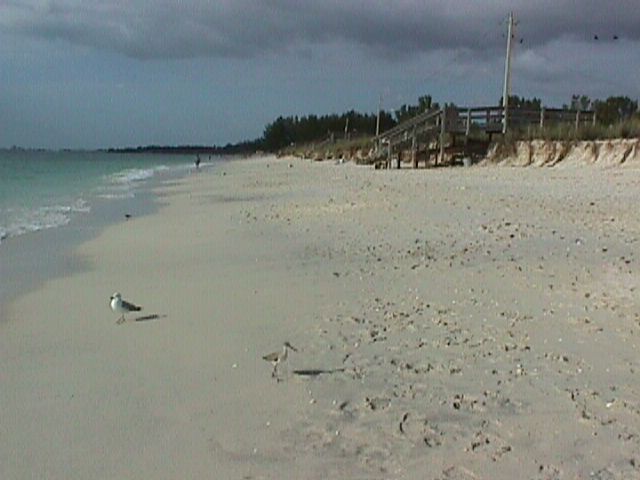
All of the southwest Florida beaches have a relatively gently slope from the dunes to the water's edge. Some are extremely wide and flat, like Siesta Key beach. Others, like Turtle beach have a more pronounced slope, though it could not be described as steep by any stretch of the imagination. Some beaches may have a "scarp," or small cliff caused by waves eroding the beach. North Lido beach has a scarp at the base of the dunes, and Lely Barefoot beach, near Wiggins pass sometimes has a small scarp about 2 or 3 feet high close to the water's edge. Last time I was there, the beach right at the pass had a 5 foot scarp.
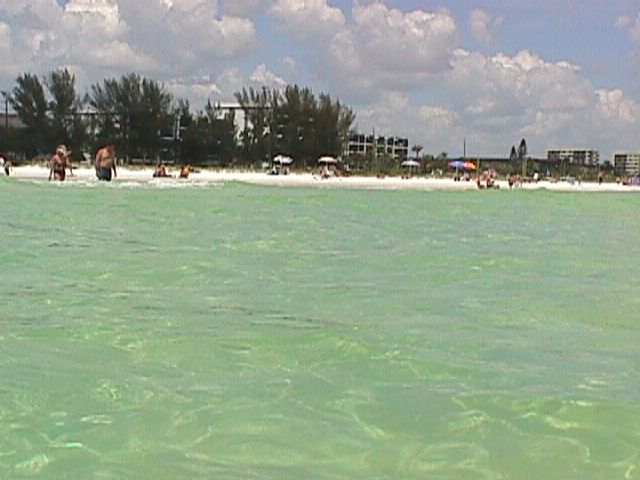
The quality of the water varies considerably from place to place. Many factors influence the color and clarity of the water. The presence of surf more than 2 feet high will always stir up the sand and cause the water to lose some clarity. Heavy rains wash silt and nutrients down from the land, causing cloudy water and an algal bloom. Hot summer temperatures and strong sunlight will also cause algae to grow rapidly and cloud the water. The Gulf water is usually at its clearest during late spring and early summer before the rains start and the temperature soars. May and early June is the time for snorkeling and diving. Below is a photo taken just north of Siesta Public beach during early July showing very good water clarity and a light yellow-green color indicative of a white sandy bottom. Boy was it a hot day! Longboat Key and Siesta Key usually have better water clarity than most beaches on any given day, although most beaches on the lower Gulf coast have clear water during the spring and early summer months.
|
|
 |
For natives like myself, water temperature is VERY important. I like it to be above 82 degrees Fahrenheit. It can easily rise to 88 or 89 degrees in the dead of summer and it may drop to a little below 60 degrees during the cooler winters. Brrrr!
Another important aspect of every beach is its accessibility. This is becoming more of a problem as more and more people are coming to the beach. Public (city, county, or state) beaches usually have the best parking, restroom, picnic, and concession facilities. The drawback is that many of the parking lots can be full by 11:00 am during peak times of the year, especially when located near major population areas. Siesta Public Beach is a great example of this. Get there early or forget it.
Beaches in residential neighborhoods are the quietest and most relaxing, but street parking is heavily restricted if allowed at all. Also these beaches have no restroom facilities or lifeguards. The more remote beaches are usually state or county parks and may or may not have facilities and parking.
Well, that's the quick tour! There are lots more photos of specific beaches on the rest of the website.
 |
FLORIDA BEACHES BOOK To find out all the important details about all the beaches on the lower Gulf Coast of Florida, consider purchasing my book: Florida Beaches - Finding Your Paradise on the Lower Gulf Coast. It covers all the beaches from Dunedin to Marco Island, more than 96 named beaches. It has 176 pages, 25 maps, and 48 black and white photographs. |
Go to the site index and list of beaches.